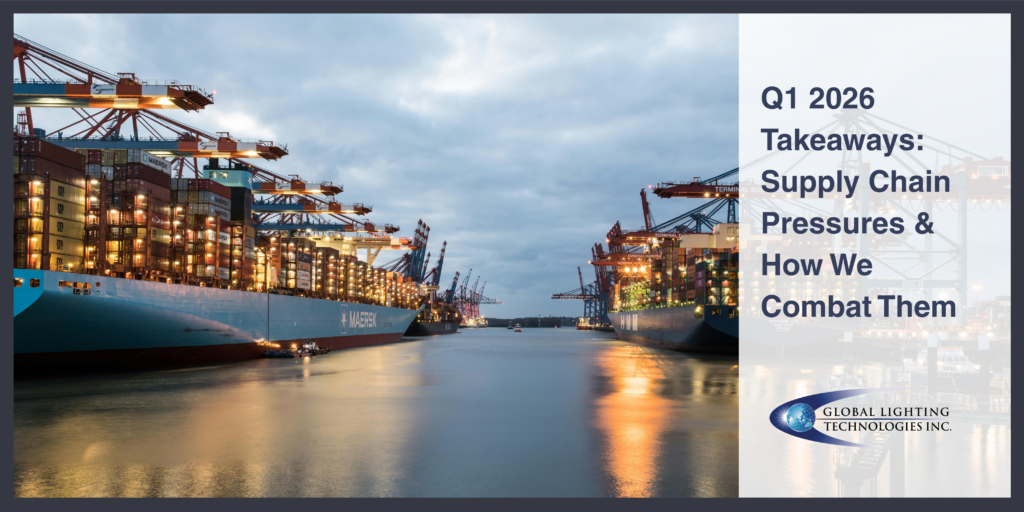
Supply chain issues? You’re not alone.
As we closed Q1, I wanted to take a step back to evaluate what we’re seeing across the industries we serve.
The biggest thing on everyone’s minds right now is supply chains.
No matter the industry, nearly every conversation we’ve had this quarter has circled back to the same supply chain pressures: rising shipping costs, tighter supplier margins, and the growing difficulty of scaling operations reliably. Many of our customers are actively rethinking where and how they source.
We’ve seen a notable uptick in requests to explore multi-location production, not just as a cost play, but as a resilience strategy. Whether by bringing operations closer to existing facilities or by distributing risk across regions, the goal is the same: less exposure to sudden disruptions. It’s a smart move, and one we’re well-positioned to support.
What we’ve learned: smarter shipping saves real money
One thing that’s become clearer than ever: routine ordering patterns don’t always translate to efficient shipping. When order quantities and schedules aren’t optimized, customers end up paying for partial shipments that could easily have been consolidated. That’s money left on the table.
Part of what we do (and genuinely enjoy) is working alongside our customers to identify those opportunities. We adjust quantities to maximize container loading, refine lead time expectations, and map out multi-site logistics as our commitment to true partnership, not transaction. If cost efficiency is a priority for you heading into Q2 (and for most, it is), let’s talk.
What to know about light guide manufacturing going into Q2
If there’s one thing to take away from Q1 about light guide manufacturing, it’s this: it’s as much an aesthetic process as it is a technical one. Brightness and uniformity specs matter, but so does how a product looks and feels in the real world. Every customer has a distinct visual language for their products, and our job is to translate that into a light guide that actually delivers it.
That process works best when there’s open, ongoing communication between our engineers and our customers, especially as requirements evolve through pre-production. Unlike some manufacturers who lock in specs and disappear, we want to be in the conversation as your product takes shape. That kind of collaboration is what consistently produces outcomes our customers are proud to ship.