Key Takeaways
- Smart manufacturing defined: the use of technology to meaningfully improve our output to benefit customers.
- Benefits include faster production and market launches, consistently high-quality parts, and lower risk of functional or cosmetic defects.
- Smart manufacturing enhances our highly skilled workforce, it doesn’t replace it.
At GLT, we define smart manufacturing as the use of technology to meaningfully improve the design, assembly, inspection, and tracking of highly customized light guide assemblies.
Our approach encompasses four areas:
- AI application development
- Machine vision
- Automation equipment development
- Process digitalization
While some of these technologies are well-established across manufacturing, their value in our operations comes from how our teams adapt and develop them for custom applications. Our programmers and engineers develop software, build models, and create automated equipment specifically for processes that often can’t be addressed with off-the-shelf solutions.
Below, we’ll cover each core technology in more depth, starting with how our suite of advancements ultimately benefits our customers.
The Benefits of Smart Manufacturing & Assembly
Our smart manufacturing capabilities have developed gradually alongside our business. As we’ve expanded into manufacturing and assembly on a larger scale, we needed technology that could help our talented workforce do more, and do it more accurately. The goal of our technological advancements is to apply what we’ve learned from decades of precision optical manufacturing to new products, technologies, and production challenges.
For customers, the investment in advanced manufacturing and assembly technology supports three important outcomes: faster production and market launches, consistently high-quality parts, and lower risk of functional or cosmetic defects. Bringing technology development in-house also reduces the number of outside suppliers required for certain programs, giving us greater control over both development and production.
That quality focus is especially important in optical manufacturing, where defects can be immediately visible. Smart manufacturing gives us additional tools to inspect more parts, identify problems earlier, reduce waste, and maintain the quality standards our customers expect.
AI Application Development: Turning Experience Into Smarter Inspection
AI application development is one of the most significant areas of our smart manufacturing investment.
One application involves building models from the knowledge and information we’ve accumulated through years of light guide design and manufacturing. Those models allow us to leverage past experience as we continue improving light guide development and related processes.
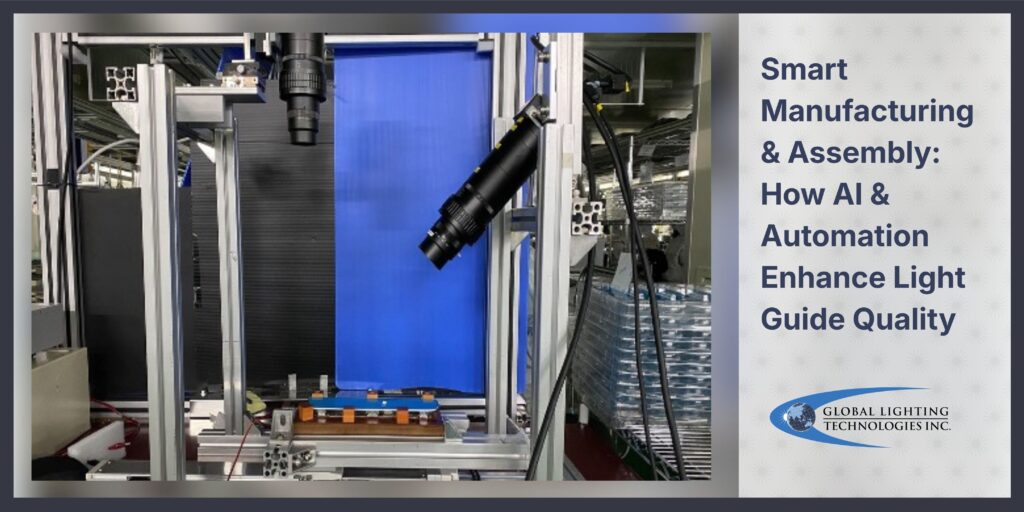
AI-supported optical inspection also expands what we can evaluate during manufacturing. Cameras, computers, and software can read barcodes, inspect assembled components, and verify that parts are physically present without requiring an operator to manually pick up and inspect every assembly.
We use AOI systems for multiple purposes. Components can be scanned and tracked as they enter an assembly, creating traceability if an issue with a vendor or component is identified later. The same systems can support defect analysis, such as detecting black specks or flow marks and determining whether a light guide meets a customer’s cosmetic requirements.
Inspection becomes even more valuable when components are exceptionally small. For example, AIO can verify the placement of O-rings and other high-precision components that may be difficult to inspect reliably with the human eye. A missing O-ring can compromise a product’s seal and create problems later in testing or use. Identifying the issue during assembly allows it to be addressed sooner.
Machine Vision: Inspecting More, and More Consistently
Machine vision supports defect detection, dimensional measurement, and quality assurance. Traditionally, trained operators used gauges and other measurement equipment to inspect parts against detailed cosmetic criteria. Cameras can now supplement that expertise by scanning far more parts quickly and consistently.
Yes, it makes inspection faster, but it can also be used to maintain an existing sampling rate in less time or inspect a much larger percentage of production in the same amount of time. For some GLT assemblies, machine vision and AOI systems make 100% inspection possible at specific production steps. Images can also be retained, creating a quality record rather than a simple pass-or-fail check.
Automation Equipment Development: Building the Equipment the Process Requires
Automation equipment development is another major focus because our manufacturing challenges are hardly ever standard.
We first explored robotic assistance with outside equipment developers. Over time, the limitations of that approach became clear. Custom manufacturing required repeated involvement from external vendors whenever a product or process changed. Bringing equipment development in-house gave our engineers more flexibility and greater ownership of the process. Today, we source proven components such as motors and other hardware when appropriate, then determine how to assemble, program, and apply them to its own production requirements.
Consider a backlight assembly. A traditional process may require operators to position a housing, light guide, optical films, adhesives, and sometimes a PCBA. In an automated line, individual work cells can perform those steps using equipment such as robotic arms and suction systems.
The difficult part is teaching equipment to handle the details. Optical films may arrive with protective release liners that must be removed without damaging or contaminating the component. Automating a task that is simple for a human hand requires programming, testing, and repeated refinement until the process can handle each scenario consistently. Closed automated work cells can also add another layer of protection against dust and contamination during assembly.
Automation is particularly valuable for higher-volume programs. In some cases, a line that may otherwise require 10 to 15 people can operate with two or three, allowing skilled employees to focus where human judgment and experience provide greater value. Lower-volume programs may still make more sense to assemble manually.
Process Digitalization: Better Visibility Behind the Production Line
Process digitalization supports the other technologies through electronic document management, barcode-based material tracking, and real-time inventory tracking. These systems create greater visibility into the materials, information, and records surrounding production and help teams maintain more consistent, traceable processes.
Technology That Extends Human Expertise
Smart manufacturing doesn’t eliminate the need for a highly skilled workforce. We continue to rely on trained operators, engineers, and manufacturing professionals, particularly for lower-volume work and tasks that require judgment and experience.
Instead, automation and digital tools allow people and technology to do the work each handles best. They also help us maintain consistent production as labor availability changes and make it easier to scale proven manufacturing processes into new facilities.
For us, smart manufacturing is ultimately another extension of custom engineering: develop the process, equipment, and technology required to manufacture each product with greater quality, consistency, and control.
Do you have a manufacturing challenge involving illumination that requires more than an off-the-shelf solution? Contact our team today to discuss your application.