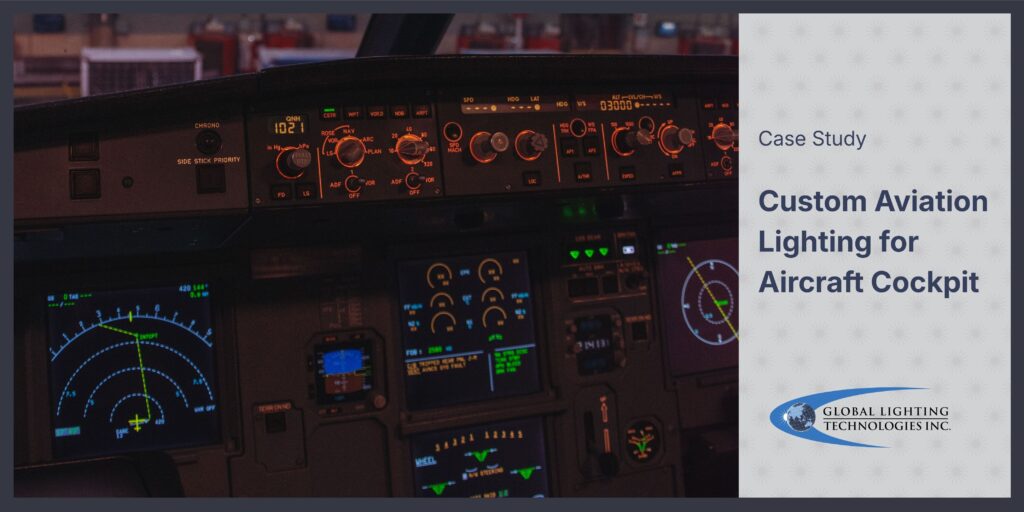
Key Takeaways
- Aviation lighting requires high brightness, efficiency, and attention to detail because the stakes are very high.
- High-brightness applications like aviation lighting involve trade-offs among efficiency, uniformity, and heat.
- Expert light guide manufacturer teams can balance requirements because they understand how every system element works together.
An existing customer serving the consumer electronics and aviation markets came to us with a demanding display application: develop a custom backlight for an aircraft cockpit that could deliver exceptional brightness, efficiency, and uniformity. All of this needed to be contained within a highly specific mechanical design.
We had completed previous work with this customer, but this program presented a new set of requirements. In aviation applications, a backlight that performs well under typical indoor conditions isn’t enough. The display must remain clear and usable in a high-ambient-light environment while also managing the power and heat required to achieve that brightness.
The result was a deeply collaborative project that required us to optimize the entire lighting system around the customer’s application, from the mechanical configuration of the light guide to its optical pattern and the placement of the LEDs around it.
The Challenge: Maximum Brightness Without Sacrificing Efficiency or Uniformity
For a cockpit display, visibility is critical. The significant ambient light entering an aircraft cockpit can make a conventional display difficult to read, so this application required a backlight capable of producing extremely high brightness.
An off-the-shelf backlight wasn’t an option. The customer had specific requirements for the display’s length, width, thickness, and overall configuration, along with unusually demanding targets for optical efficiency.
Efficiency, in this case, refers to how much of the light produced by the LEDs ultimately reaches the display and the end user. Light can be lost at several points throughout a backlighting system, including where the LEDs couple into the light guide and as light travels through the guide and other display components. The more of that light we can preserve and direct where it belongs, the more efficiently the system performs.
That efficiency also has implications beyond brightness. A highly efficient light guide can give the customer the ability to operate the LEDs at a lower output while still achieving the required display brightness. In turn, that can reduce power consumption and heat generation.
Heat was particularly important for this application. Excess heat can affect electronic reliability over time, and it can also influence the user experience with the display.
At the same time, efficiency couldn’t come at the expense of optical quality. The backlight still needed to appear uniform, without visible bright spots, dark areas, or other inconsistencies. Achieving both goals simultaneously made this a significantly more demanding engineering challenge than a typical backlight build.
The Solution: Custom Mechanical and Optical Design Working Together
Our advantage on this project was the ability to control both major contributors to light guide performance: the mechanical design of the light guide and the optical pattern used to extract and distribute light.
We worked with the customer to evaluate how the light guide should fit within the larger display system, including its size, shape, and LED positioning. We also needed to consider the space maintained between the LEDs, light guide, and display. That meant evaluating both flat and wedge-shaped light guide configurations and understanding the benefits and compromises of each.
Once the mechanical direction was established, our optical team developed the light guide pattern needed to distribute the available light as efficiently and uniformly as possible.
The LED configuration added another layer of complexity. Rather than using a conventional array of white LEDs, the customer selected colored LEDs that work together to achieve specific white points. These weren’t LEDs we would typically use across most programs, so the light guide had to be optimized around their unique characteristics while maintaining consistent illumination across the display.
We supported the program with the full range of GLT capabilities, including custom light guide design, optical pattern development, simulation, prototyping, tooling, and production.
The Approach: Designing the Light Guide and the System Around It
A strong light guide design only performs as intended when the surrounding system is designed to support it. That made close collaboration with the customer essential throughout development.
The customer brought significant display and electronics expertise to the project and had already selected key components, including the LEDs. Our role was to help determine how those components and the surrounding mechanical design could best leverage the light guide.
We worked closely with their team on considerations such as LED spacing, LED proximity to the edge of the light guide, available coupling area, light guide geometry, and integration with the display housing.
Simulation played a major role in evaluating those variables before moving further into development. Because this application pushed efficiency requirements beyond those of many conventional backlights, previous experience alone couldn’t determine the best configuration. We relied heavily on upfront engineering and simulation to compare potential designs and predict how changes would affect both efficiency and uniformity.
From there, prototyping allowed the teams to validate performance and continue refining the system.
This type of development can take months because small decisions throughout the system affect the final optical result. Each new requirement, component change, or LED selection has the potential to alter the way the light guide must perform. In many ways, programs like this become their own R&D efforts, even when the underlying product is a technology we know extremely well.
That collaborative process extended beyond simply adapting our light guide to the customer’s design. We also worked with the customer to refine aspects of their system so it could better leverage the light guide. By considering both sides together, we could address potential performance issues early rather than optimizing a light guide in isolation and discovering later that the surrounding system limited its effectiveness.
The Impact: High Efficiency and Uniformity in a Demanding Application
The most important outcome of the project was the ability to maintain two demanding performance characteristics at the same time: high optical efficiency and consistent uniformity.
The custom light guide helps direct as much available LED light as possible toward the display while maintaining the even illumination required for a high-quality visual experience. Greater efficiency also gives the customer more flexibility in how aggressively the LEDs need to operate to achieve the required brightness, creating an opportunity to reduce power consumption and heat within the display system.
Just as important, the engagement strengthened an existing relationship by expanding the role we could play in solving the customer’s engineering challenges.
On paper, a light guide may be one component within a much larger display. In practice, its design can directly affect the appearance, performance, efficiency, and user experience of the finished product. For a demanding cockpit application, getting those details right required more than providing a molded part. It required an engineering partner capable of understanding how every element of the lighting system works together.
Bring Your Most Demanding Backlight Challenges to GLT
High-brightness applications often require careful tradeoffs between efficiency, uniformity, heat, form factor, and the surrounding electronics. Our team works alongside customers to evaluate those variables early and develop custom light guides around the performance requirements of the complete system.
If your team is developing a display that conventional backlighting can’t support, contact our team to start the conversation.