Key Takeaways
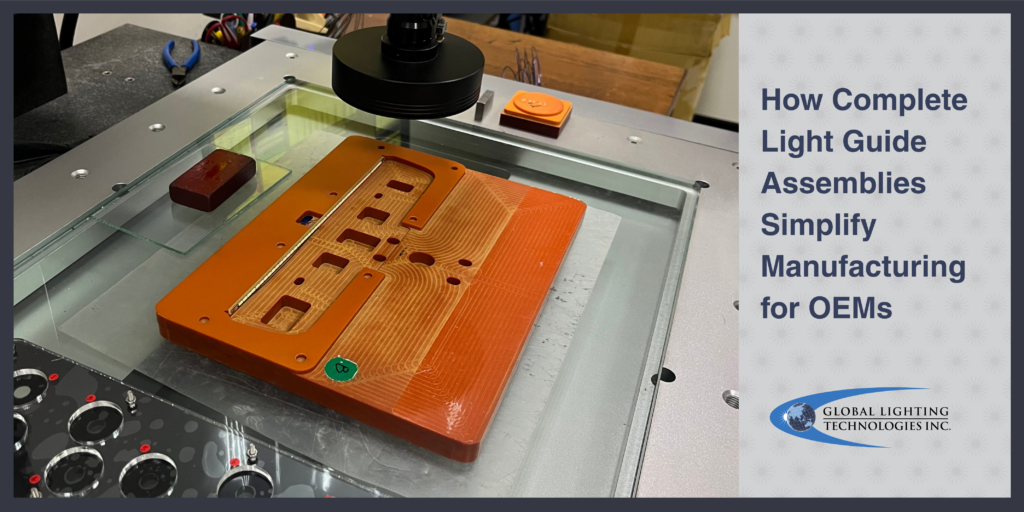
- Complete light guide manufacturing and assembly reduces supplier handoffs, streamlines production, and minimizes coordination challenges for OEMs.
- Integrated design ensures LEDs, optical films, and other components work together to maximize efficiency, uniformity, and reliability.
- Custom assembly equipment and system-level testing help maintain design intent, consistent quality, and manufacturing efficiency.
What if your light guide manufacturer could deliver more than just the light guide and handle your entire assembly from design through production?
At Global Lighting Technologies, we’re expanding the way we support OEMs by integrating assembly capabilities into our light guide manufacturing. This means bringing optical engineering, component sourcing, precision manufacturing, and assembly together under one partner.
For OEMs, this approach addresses a familiar challenge: coordinating multiple suppliers to produce components that ultimately need to function as one system.
A light guide might be the foundation of an illumination solution, but its performance depends on much more than the guide itself. LEDs, optical films, reflectors, housings, and other components all influence the finished product.
By taking responsibility for more of the complete assembly, we can help OEMs simplify manufacturing, maintain design intent, and achieve their illumination goals with fewer compromises.
The Entire System Matters More Than You Think
When developing light guide assemblies, it’s important to consider how every component affects optical performance.
For example, a light guide might deliver excellent uniformity during individual testing, but its performance can change once it’s integrated with surrounding components. Housing materials, colors, and geometry can influence how light travels through the system. Even components outside the assembly can introduce unwanted reflections.
That’s why we begin evaluating the complete application during the earliest stages of a project.
Our engineers consider several interconnected factors:
- Optical performance: How LEDs, optical films, and light guide geometry work together to achieve brightness and uniformity requirements.
- Mechanical integration: How housings, spacing, and component placement affect the finished assembly.
- Power efficiency: Whether LED placement or quantity can be optimized without compromising illumination.
- Manufacturability: How the complete design can be produced and assembled consistently.
We source certain components, including optical films, from qualified suppliers. What matters is understanding how those components perform together and adjusting the light guide design accordingly.
When we manufacture only the light guide, the customer typically manages this system-level integration. When we produce the complete backlight assembly, we take greater responsibility for ensuring the components work together to meet the customer’s requirements.
Individual Components vs. Complete Light Guide Assemblies
One of the biggest opportunities in integrated manufacturing and assembly is finding ways to simplify the overall design. It’s a challenge we’re well-positioned to solve!
For example, we frequently identify opportunities to reduce the number of LEDs or adjust their placement. Because our engineers understand how optical patterns, LED positioning, and surrounding materials interact, we can evaluate different configurations to achieve the desired illumination. We can also identify alternative optical films and component suppliers that may be more accessible or better suited to the application.
An efficient light guide assembly isn’t necessarily the one with the fewest components; it’s the one that achieves the required performance while balancing cost, manufacturing complexity, and reliability. Our integrated approach allows us to address these considerations together rather than treating each component as a separate engineering challenge.
For OEMs, that can mean fewer supplier handoffs, less coordination between vendors, and a more streamlined path from design to finished assembly.
Precision Assembly Requires More Than Optical Expertise
Designing a high-performance backlight module is one challenge. Manufacturing it consistently is another.
Many light guide assemblies contain small components that require precise placement, alignment, and spacing. In these applications, manual assembly may not provide the repeatability or throughput needed for production.
To address these challenges, we’ve developed custom assembly equipment in-house, including the software and integration needed to operate, service, and maintain production.
This capability gives our engineers greater flexibility when developing unique assemblies.
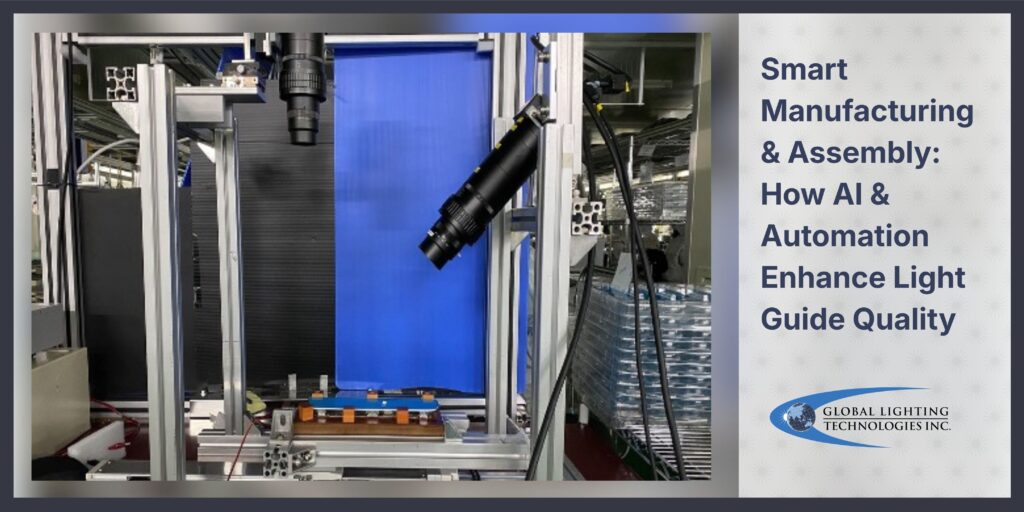
See how we’re leading in smart manufacturing and assembly.
Rather than limiting a design to what can be assembled using standard equipment, we can evaluate custom manufacturing solutions that support the application’s specific requirements.
The potential benefits include:
- More consistent component placement and alignment
- Greater production throughput
- Reduced assembly costs
- Increased flexibility for custom designs
For OEMs, this is especially valuable when a product requires both precise optical performance and repeatable high-volume manufacturing.
Testing the Complete Assembly, Not Just the Light Guide
A light guide that meets its individual specifications doesn’t automatically guarantee that the finished backlight module will perform as expected.
Once the components are integrated, new variables can affect optical performance.
For example, environmental conditions such as temperature and humidity may have little effect on an individual light guide but create problems for other components within the assembly.
Similarly, reflections or interactions with surrounding product components may become apparent only after the complete system is evaluated. That’s why testing must reflect the finished application’s requirements.
We work with customers to establish performance criteria before mass production. Depending on the application, these may include brightness, uniformity, dimensional accuracy, cosmetic quality, and environmental reliability.
Our engineers use industry-standard evaluation methods, with acceptance criteria agreed upon with the customer. This approach helps ensure that we’re not simply producing components that meet individual specifications. We’re manufacturing assemblies designed to perform as intended within the customer’s product.
What Integrated Manufacturing Means for OEMs
As product designs become more complex, OEMs increasingly need manufacturing partners that understand the entire system, not just individual components.
Working with separate suppliers for optical design, component sourcing, manufacturing, and assembly can create additional coordination challenges. Not to mention the time it takes to vet each vendor properly! When performance issues arise, determining which component or supplier is responsible can also become more difficult.
An integrated partner provides a different approach. By combining light guide manufacturing and assembly, we can maintain greater continuity between the original design requirements and the finished product.
Continuity helps us respond to engineering challenges, evaluate alternatives, and preserve design intent throughout development and production. It also allows you to spend less time coordinating suppliers and more time focusing on your broader product development goals.
Your Partner for More Than Light Guide Manufacturing
Our expertise in custom light guide design remains central to everything we do. But as customer needs evolve, the solutions we provide do, too.
Complete manufacturing and assembly is a natural extension of our optical engineering and manufacturing capabilities.
By combining component sourcing, custom equipment development, precision assembly, and system-level validation, we’re helping OEMs approach illumination as one integrated manufacturing challenge.
Our goal is to make the entire process easier for OEMs while delivering the optical performance their products require.
If you’re developing a product that requires a custom backlight assembly, involving our engineering team early can help identify opportunities to simplify integration, improve manufacturability, and reduce unnecessary compromises.
We’re ready to help you look beyond the light guide! Contact our team to start the conversation.